01 — Where This Started
Ludo Star and Parchisi Star were successful titles using an established creative
model. MatchStar 3D was the studio's first puzzle game. The core challenge
involved developing team capability, creative systems, and operational
infrastructure to discover and sustain creative language for an unfamiliar
genre — while learning it simultaneously.
The playbook that worked for board games ran out at the door of MatchStar. What
followed was building a new one — under live conditions, with the game already
in market.
02 — Building the Operation
Two testing directions emerged as viable hypotheses: narrative-driven
saviour-complex storytelling versus 3D tactile gameplay mechanics. Rather than
committing prematurely, the team adopted a rapid prototyping principle —
giving individual contributors genuine responsibility from research through
execution, using iteration speed as the learning engine. The approach
prioritized understanding why solutions worked, building
evidence-reading capability into the team structure rather than concentrating
it at directorial levels.
Creative Marathon mode: motion designers researched, developed,
and pitched individual concepts, embedding market understanding throughout the
team. LOC Testing Framework: structured output around distinct
lines of communication, systematically testing different player motivations and
visual registers. Gameplay Templating: repeatable production
frameworks for 3D and 2D tactile formats reduced rebuild time, allowing
designers to prioritize conceptual quality. Vendor scaling:
external partners integrated through pre-production alignment, tight briefing,
and iterative quality investment.
The team produced 10–12 in-house creatives and 12–16 vendor-created pieces
bi-weekly during the tactile phase. When narrative became priority, volume
reduced to 3–5 in-house and 6–8 outsourced, reflecting the greater craft
complexity required.
03 — Growing the Team
The pivotal shift involved how motion designers worked. Early research
struggles revealed the gap between executing briefs and originating concepts.
Timebox marathon sessions were established where designers pitched researched
concepts to the group, including the performance lead, with one non-negotiable
standard: the match-3 mechanic had to remain present and legible.
The goal wasn't a team that executed briefs well. It was a team that understood
the market well enough to generate their own.
04 — What Testing Revealed
Structured testing initially showed strong performance for non-narrative 3D
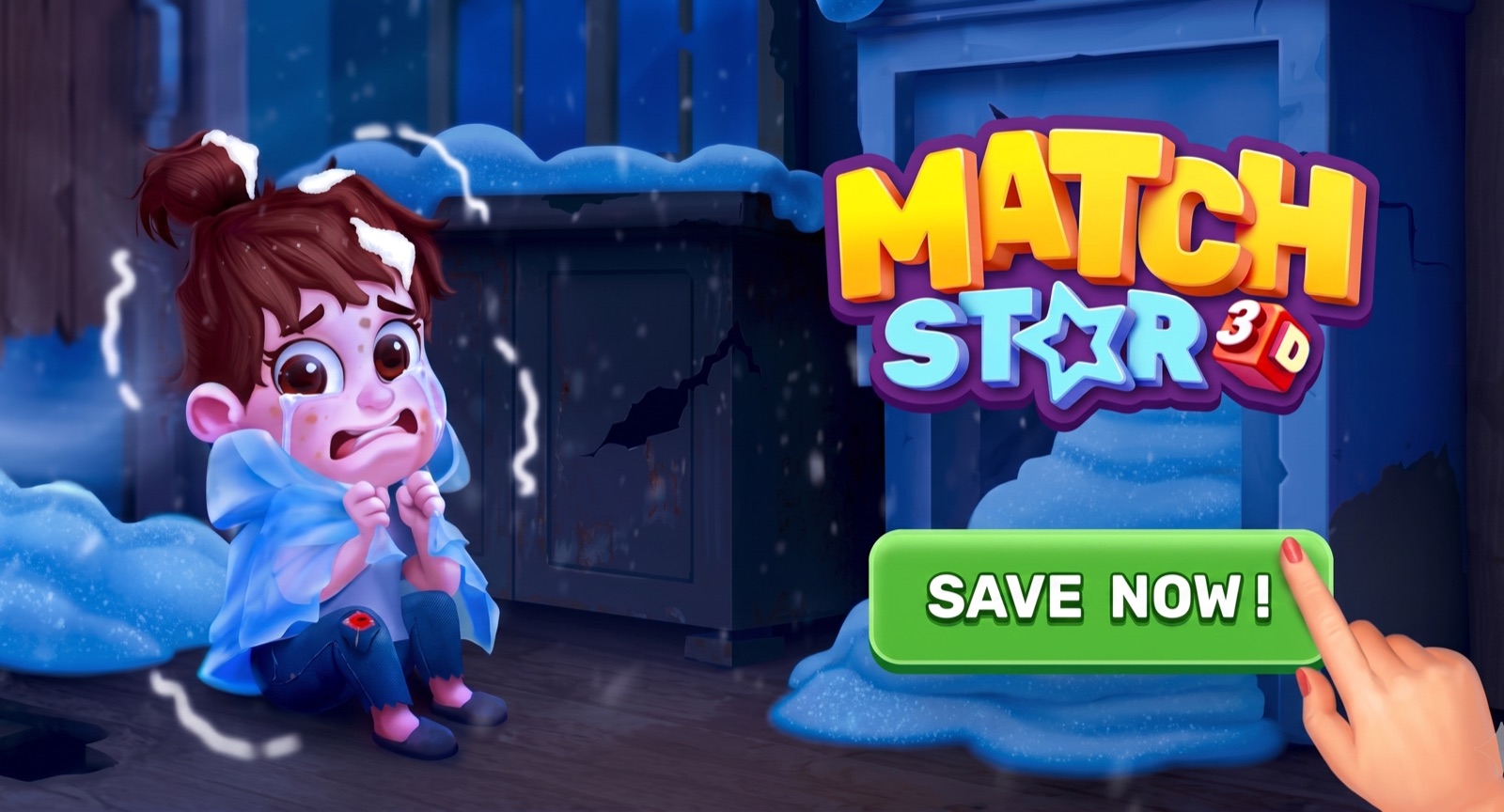
tactile gameplay. A narrative concept — a dying child and mother in snow —
then performed exceptionally on one cut, shifting production priorities and
delivering a 3.5× IPM lift on the breakthrough.
Phase progression: Phase 1 — parallel 3D tactile and narrative
testing; 3D tactile showed early strength. Phase 2 — narrative reintroduced;
standout performer; production pivoted toward optimization. Phase 3 — narrative
commoditized as competitors converged; storyboard artist hired for fresh angles.
Phase 4 — original cinematic storytelling explored; reasonable performance met
broader market saturation.
A critical insight emerged: 3D tactile worked because of end-to-end alignment —
the hook matched what players wanted to do, and gameplay matched that desire.
The signal was consistent across multiple tests, forming a recognizable pattern
rather than isolated success.
05 — Being Honest About the Outcome
MatchStar ultimately faced structural retention challenges — difficulty curves
correlating with IAP drop-off as players progressed. Narrative saturation added
market pressure. These factors combined decisively against the game's
commercial viability.
The distinction matters: the creative operation was generating structured
evidence, reading it clearly, and adapting to market signals while building
genuine capability. The game's commercial trajectory operated in conditions
beyond marketing's control. The meaningful output wasn't measured in game
metrics but in what the experience produced — a creative operation capable of
structured experimentation at scale, designers thinking strategically, and
frameworks for understanding creative-to-product alignment.
06 — What This Team Became
When Gameberry Labs approached Draw Match — its most ambitious, highest-stakes
creative challenge — it entrusted the team built and refined through MatchStar.
The performance lead, creative strategist, storyboard artist, and
strategically-minded motion designers all emerged from MatchStar's demands.
That handoff is, to me, the clearest measure of what the MatchStar period
produced. Not the metrics of any individual campaign — but the fact that a
studio facing a genuinely new kind of problem looked at this team and decided
it was the right one to solve it.
Credits
Creative + Art Direction by Yaseen Malik. Multi-pod team in Bangalore (motion,
creative strategy, storyboard) with external vendor partnerships in India and
Vietnam for art asset and animation overflow. In partnership with performance
marketing, creative strategists, product, and analytics at Gameberry Labs.